The recent US military strikes in Venezuela have ignited a firestorm of global condemnation, triggered major geopolitical debate, and raised profound questions about international law and national sovereignty. In a dramatic showdown that marks one of the most significant military interventions by the United States in decades, President Donald Trump’s administration announced that its forces had conducted coordinated air and special operations strikes inside Venezuelan territory, culminating in the capture and removal of Venezuelan President Nicolás Maduro and his wife from the country.
This unprecedented action — involving explosions across Caracas and other regions reported in the early hours of January 3, 2026 — has rapidly dominated global news cycles, sparked urgent Security Council discussions, and drawn sharp critique from governments across continents.
Sudden Strikes and Maduro’s Capture: What Happened
In pre-dawn operations, US forces launched extensive strikes across multiple Venezuelan locations, including the capital, Caracas. Explosions echoed through residential neighbourhoods, sirens blared, and panic surged among civilians as low-flying aircraft swept the skies.
According to official statements from the White House, Venezuelan President Nicolás Maduro and his wife, Cilia Flores, were apprehended by elite US military units and transported out of Venezuela to face charges in the United States. Trump’s administration characterized Maduro’s government as a narco-terrorist regime responsible for trafficking operations and regional destabilization.
This bold move echoes previous American interventions in the region but represents the most direct military intrusion since the 1989 invasion of Panama — a benchmark comparison made by analysts worldwide.
International Outrage: Searing Condemnations
The world’s reaction has been swift and overwhelmingly critical. Many nations and global institutions have condemned the US action as a blatant violation of international law and a dangerous breach of Venezuelan sovereignty.
China issued a strong statement condemning the strikes as a violation of international law and a threat to peace and stability in Latin America and the Caribbean. Beijing urged the United States to adhere to the UN Charter and respect national sovereignty.
Similarly, Russia described the operation as “an act of armed aggression” and demanded urgent clarification from Washington regarding Maduro’s forced removal.
Latin American nations were particularly vocal. Brazilian President Luiz Inácio Lula da Silva condemned the strikes as an “unacceptable line crossed,” urging the UN to respond decisively, while Colombia’s leadership denounced the actions as an “assault on the sovereignty of Latin America.”
Iran’s foreign ministry echoed these sentiments, emphasizing that the attack violated core principles of national sovereignty and the United Nations Charter and urging global institutions to hold Washington accountable.
Cuba’s president branded the action as “state terrorism,” calling for a robust global response, while Mexico and several European leaders expressed serious concern about the humanitarian and legal fallout.
Legal and Moral Controversies Surrounding the Strike
International legal experts have weighed in sharply against the strikes. Critics assert that the unilateral use of force on sovereign territory without explicit UN Security Council authorization breaches the UN Charter, particularly the prohibitions on military aggression and interference. These violations could set perilous precedents undermining global legal frameworks meant to safeguard peace.
United Nations Secretary-General António Guterres described the operation as a “dangerous precedent” and expressed deep concern that such actions threaten the integrity of international law, calling for restraint and respect for established norms.
Even within the United States, legal scholars and some lawmakers questioned the constitutional basis for the strikes, noting that Congress was not consulted, and the justification for military action under US law remains unclear.
On the Ground in Venezuela: Chaos, Emergency, and Civil Anxiety
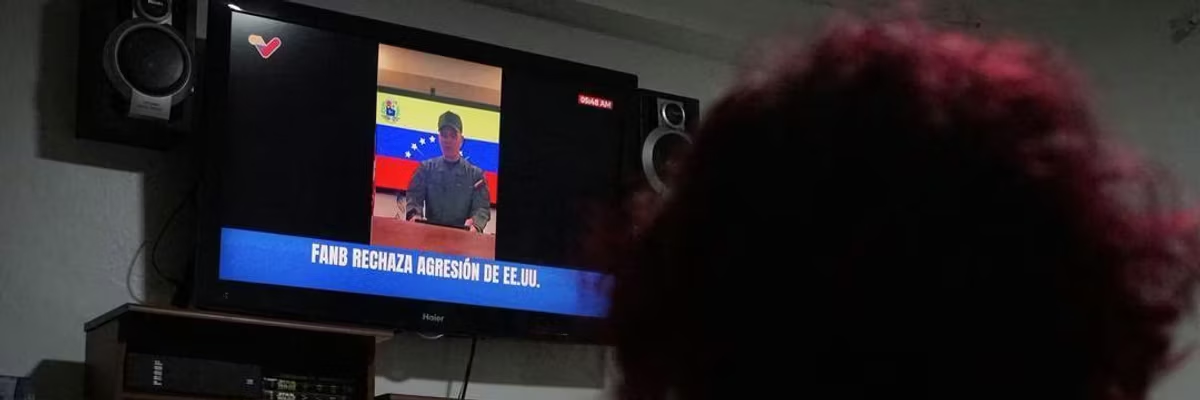
Residents across Caracas reported at least seven powerful explosions in the early morning hours, followed by widespread panic, sudden power outages, and a city on edge. Emergency declarations were issued, and Venezuelan authorities decried the assault as criminal aggression against civilians and military infrastructure alike.
Maduro’s government immediately condemned the attack, declaring a nationwide state of emergency and calling for citizens to reject foreign intervention. Amid the chaos, civilian life was disrupted, and concerns about a possible power vacuum intensified, as the country’s leadership structure faced sudden upheaval.
Opposition figures within Venezuela have responded with mixed reactions. Some saw the removal of Maduro as a potential turning point toward democratic renewal, while others warned that external intervention may engender deeper instability and long-term conflict.
Economic and Strategic Implications: Oil and Regional Power Dynamics
Experts believe that the strike’s strategic implications extend far beyond immediate military outcomes. Venezuela’s vast oil reserves — among the world’s largest — have long been a focal point of geopolitical interest, and critics argue that control over these resources could be an unspoken motivation behind the intervention.
Despite official US statements framing the operation as part of anti-drug and security objectives, adversaries have underscored the linkage between military intervention and resource leverage, warning that this could intensify global competition for energy dominance.
Economists also caution that such a dramatic geopolitical shift could unsettle global oil markets, influence emerging economies, and trigger retaliation from rival powers invested in Venezuelan energy infrastructure.
What Comes Next: Diplomatic Strain or Peaceful Resolution?
In the aftermath of the strikes, the international community faces a critical crossroads. Calls for an emergency UN Security Council session have intensified, with major powers like Russia and China pushing for urgent debate, while regional blocs emphasize the necessity of de-escalation and respect for sovereignty.
European leaders, while critical of the intervention’s legality, have also urged restraint and highlighted the importance of protecting civilians and avoiding a broader conflict.
Meanwhile, US allies and domestic political factions are divided, with some endorsing the move as a decisive blow against corruption and criminal governance, and others warning that unilateral military action could isolate the United States diplomatically. The Guardian
Conclusion: A Defining Moment in Global Geopolitics
The US military strikes in Venezuela and the dramatic capture of President Maduro have unfolded into one of the most consequential foreign policy events in recent history. What began as a surprise military operation has rapidly become a global flashpoint, drawing sharp divisions among nations, legal experts, and global institutions.
As the world watches whether diplomacy, renewed conflict, or political transition emerges next, the ramifications of these strikes are certain to resonate for years — reshaping alliances, challenging international legal norms, and redefining the contours of power in Latin America and beyond.
Subscribe to trusted news sites like USnewsSphere.com for continuous updates.