In the most decisive U.S. military response to date against ISIS since the fall of Assad’s regime, the United States, alongside international partners, launched large-scale strikes targeting Islamic State positions throughout Syria—Operation Hawkeye Strike—after a brutal ambush in Palmyra killed American personnel last December.
Rising Tensions and the Trigger: The Palmyra Ambush
On December 13, 2025, a routine mission near Palmyra, Syria, turned deadly when a suspected ISIS-affiliated gunman ambushed U.S. and allied forces, killing two U.S. soldiers and one American civilian interpreter. This was the first such loss of American life in the country since the Assad government’s overthrow in 2024.
The ambush not only claimed lives but marked a significant shift in ISIS’s operational capability in the region. It underscored that despite territorial defeats years earlier, the extremist group still possessed lethal cells capable of striking U.S. and allied forces. Immediately after the attack, the U.S. military confirmed that it would respond forcefully, setting the stage for a major escalation.

The attack sparked national security debates in Washington, and senior commanders emphasized that the U.S. would not tolerate assaults on its forces or partners. The response strategy was thus codified as Operation Hawkeye Strike, signaling Washington’s renewed focus on degrading ISIS’s remaining capabilities.
Operation Hawkeye Strike: A Massive Retaliatory Campaign
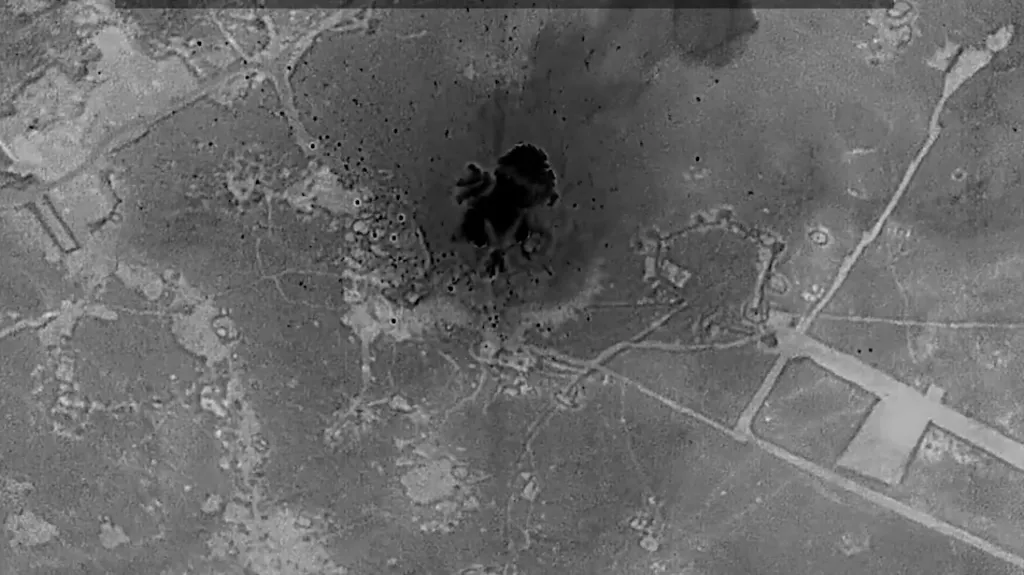
At approximately 12:30 p.m. Eastern Time on January 10, 2026, the U.S. Central Command, in coordination with allied forces, initiated a series of large-scale attacks against ISIS targets across multiple provinces in Syria. This was not a limited airstrike; the operation involved coordinated action across air, ground, and intelligence platforms.
According to military sources, over 20 aircraft participated, launching more than 90 precision-guided munitions at more than 35 confirmed ISIS locations. These targets included known militant strongholds, weapons caches, supply depots, and command centers.
U.S. officials defined the mission’s core objective as disrupting ISIS’s ability to plan and execute future attacks and sending a clear message that harming U.S. forces would invoke a swift and decisive response. In a statement read during the operation, U.S. Central Command reinforced that those who target American forces “will be found and confronted wherever they hide.”
Strategic Coordination with Allies and Partners
Operation Hawkeye Strike was not a unilateral effort. The U.S. military acted with partner forces embedded within Syria, though many partner units were not explicitly named in public releases. Officials indicated that coordination extended across intelligence sharing, joint strike planning, and ground movements.
Jordan, a key regional partner, confirmed its involvement in earlier waves of strikes and, according to some reports, continued to play a role in this latest round of operations. Cooperation with Kurdish and local Syrian forces also remains a part of broader counter-terror strategies, even as traditional alliances shift on the ground.
The Syrian government, now led by a post-Assad coalition, is reported to be strengthening its cooperation with the U.S. in the fight against ISIS—a dramatic turn from previous years of distrust and conflict. Reports suggest that strategic dialogues between U.S. diplomats and Syrian leaders have been ongoing, focused on stabilizing liberated areas and preventing extremist resurgence.
Broader Context: ISIS After Territorial Defeat
Although ISIS lost its territorial “caliphate” years ago, its operational network survived underground, especially across rural and desert zones of Syria and Iraq. Experts note that the group has adapted to an insurgent strategy—moving away from holding territory to conducting ambushes, improvised explosive attacks, and isolated strikes.
ISIS’s ability to strike U.S. and allied forces nearly 18 months after losing formal control of key regions shows that the group’s threat remains significant. Analysts note that despite almost a decade of counterinsurgency campaigns, ISIS cells retain recruitment, tactical planning, and logistical capabilities.
The U.S. and coalition partners continue to balance military operations with efforts to cut off recruitment pipelines, disrupt financial networks, and prevent extremist propaganda from gaining traction online. These multi-pronged strategies are seen as essential to preventing a reconstitution of ISIS at anything resembling its former strength.
Political Impacts of Continued Conflict
The continued conflict in Syria has left deep scars on the population. Millions have been displaced over a decade of fighting involving Assad loyalists, rebel factions, extremist groups, Kurdish forces, and foreign armies. Civilians frequently bear the brunt of military operations and displacement.
Moreover, the political landscape in Syria has shifted dramatically. After Assad’s removal, former rebel and allied factions have filled the governance vacuum. These new leadership structures open possibilities for diplomatic engagements with the U.S. and other nations previously uninterested in dealing with Assad’s government.
Critics of U.S. military operations argue that while strikes like Hawkeye are necessary to protect troops and voice deterrence, they must be paired with robust humanitarian and reconstruction support to avoid long-term destabilization. Proponents counter that degrading ISIS now prevents even larger, costlier threats in the future.
The Road Ahead: What This Means for Global Security
The latest U.S. strikes against ISIS underscore a continued American role in counter-terrorism efforts abroad. While no official casualty figures from the January 10 strikes have been publicly released, military assessments suggest significant disruption of ISIS command structures.
Experts predict that the U.S. and its partners will remain vigilant, carrying out further operations as intelligence dictates. The interplay between military action, diplomatic engagement, and partnership with local forces will shape the next chapter of anti-ISIS efforts.
What remains clear is that although ISIS no longer holds territory, the group’s remnants still pose a dangerous threat regionally and potentially globally. As long as extremist networks endure, global security efforts will involve both kinetic operations like Hawkeye Strike and longer-term strategies focusing on ideology, governance, and community resilience.
A Decisive Response Designed to Last
The January 10, 2026, strikes mark a major chapter in the ongoing U.S. counter-ISIS campaign. Operation Hawkeye Strike reflects not only military might but a strategic message: the United States and its partners remain committed to confronting extremist threats and protecting their forces and interests abroad. With coordinated international action, deep strategic planning, and evolving geopolitical partnerships, this operation represents a significant push to thwart future terrorism.
Subscribe to trusted news sites like USnewsSphere.com for continuous updates.