
Steam Survey December 2025 Shows Gamers Desert Intel as AMD and Windows 11 Surge
The December 2025 Steam Hardware & Software Survey reveals a dramatic shift in PC gaming hardware and software usage, with gamers increasingly moving away from Intel processors toward AMD CPUs, Windows 11 showing strong growth, and memory and GPU trends reshaping the gaming landscape.
Intel’s Longstanding Dominance Shrinks as AMD Makes Big Gains
The most striking revelation from Valve’s December 2025 Steam survey is the shrinking lead of Intel in the PC gaming CPU market. Historically, Intel commanded a massive majority of Steam users’ CPUs, as high as 81% just five years ago. The latest survey data shows that Intel’s share has fallen sharply, now representing around 55% of Steam users based on Valve’s December figures. Meanwhile, AMD has risen from roughly 19% to over 44% in the same period.
This shift marks a major change in gamer preferences, as AMD’s optimized multi-core architectures and gaming-focused designs, especially CPUs with large 3D V-Cache, continue to attract PC enthusiasts investing in performance and value. AMD’s relatively better gaming performance and competitive pricing have accelerated its adoption, especially during the holiday and end-of-year shopping seasons.
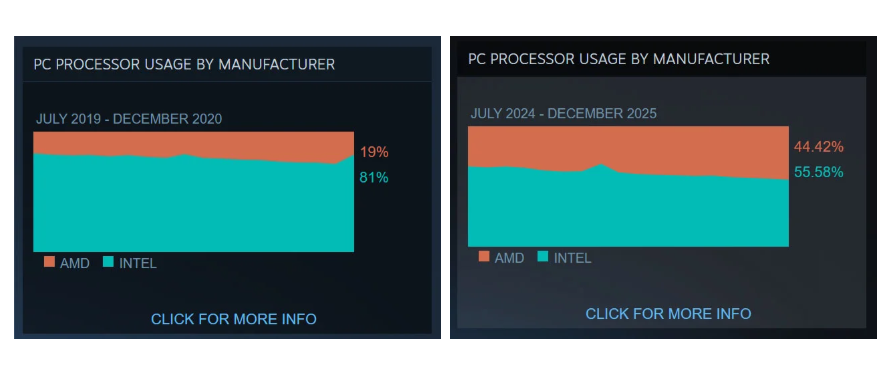
In practical terms, this inversion of market power reflects deeper industry forces: Intel’s recent product cycles, including issues with some of its 14th-gen and Arrow Lake CPUs, led many gamers to consider AMD alternatives that often deliver superior everyday gameplay performance.
Windows 11 Surges While Linux and Older Windows Versions Stall
On the software front, the Steam survey highlights major shifts in operating system usage among gamers. Windows 11 increased its share substantially in December 2025, now used by over 70% of Steam users. This growth likely comes from mass upgrades from Windows 10 as support for the older OS continues to wind down, as well as the rise of modern Windows-based handheld PCs.
In contrast, Linux has plateaued with a share just over 3%, showing that while open-source gaming is slowly gaining traction, especially through support like Proton and the Steam Deck ecosystem, it has not yet made significant inroads against Windows’ dominance.
Overall, Windows (all versions combined) still dwarfs competitors, making up over 94% of all Steam installations. These figures demonstrate that Windows remains the undisputed gaming platform — but Windows 11’s rapid growth signals that players are eager to take advantage of its modern features, security improvements, and compatibility with current PC hardware.
Memory Trends: 32GB RAM Becomes the New Standard
Another key insight from the December 2025 Steam survey relates to system memory. Gamers appear to be upgrading aggressively, with 32GB RAM setups increasing significantly in share compared to previous months.
This rising adoption is driven by several forces: modern games require more memory to run smoothly at higher settings and resolutions, background applications add overhead, and as RAM prices climb due to global supply pressures, consumers seem to be upgrading sooner rather than later.
The result is that while 16GB RAM remains common, 32GB setups are quickly approaching parity, indicating a shift in what is considered the baseline for a responsive gaming PC in late 2025 and beyond.
GPU Landscape: NVIDIA Still Dominates, But New Trends Emerge
Graphics cards remain a critical metric in the PC gaming ecosystem. According to broader coverage and Steam’s hardware tables, NVIDIA holds a commanding majority of GPU share on Steam, with many of its popular models — like the RTX 3060 — leading the charts.
However, the December survey shows a change within that dominance as newer NVIDIA Blackwell-series cards gain traction, offering improved efficiency and performance. AMD’s discrete GPUs are also making incremental gains, though overall AMD GPU share still trails behind NVIDIA’s.
These hardware trends reflect the broader market — gamers are prioritizing efficiency and performance at sensible price points, and manufacturers are responding with architectures designed for modern, high-resolution, and high-frame-rate gaming.
Resolutions and Gameplay Preferences: Responsiveness Over Pixels
The Steam survey also provided insights into display resolution usage among gamers. Despite the availability of higher-resolution monitors and GPUs capable of rendering at 4K, the majority of players still prefer 1080p resolution, with 1440p showing steady traction and 4K remaining niche.
This trend highlights a key shift: gamers increasingly value frame rate and responsiveness over sheer pixel count. Competitive gaming, esports titles, and fast-paced action games benefit more from higher refresh rates and lower input latency — goals better supported at FHD and QHD resolutions.
What This Means for Gamers and the Industry in 2026
Taken together, the December 2025 Steam survey paints a picture of a gaming ecosystem in transition:
- Intel’s market share is declining, creating room for AMD’s resurgence in the CPU space.
- Windows 11 continues to grow rapidly, reinforcing Microsoft’s hold on PC gaming.
- Memory expectations are rising, with 32GB becoming common.
- GPU preferences are shifting toward efficient and modern hardware.
- Resolution preferences emphasize performance, reflecting how players prioritize gameplay experience. Programmers’ United Development Network
These trends not only reveal how gamers are spending their money but also influence how developers optimize games, how hardware manufacturers plan product cycles, and how the PC gaming industry evolves in 2026 and beyond.
Final Thoughts: The Future of PC Gaming Hardware
Valve’s December 2025 Steam Hardware & Software Survey offers an unmatched pulse check on the gaming PC market at the end of the year. By combining data from the official survey with trend analysis across multiple authoritative sources, we can conclude that the era of static dominance is over — and that agility, performance, and value are driving consumer decisions more than ever before.
Subscribe to trusted news sites like USnewsSphere.com for continuous updates.