
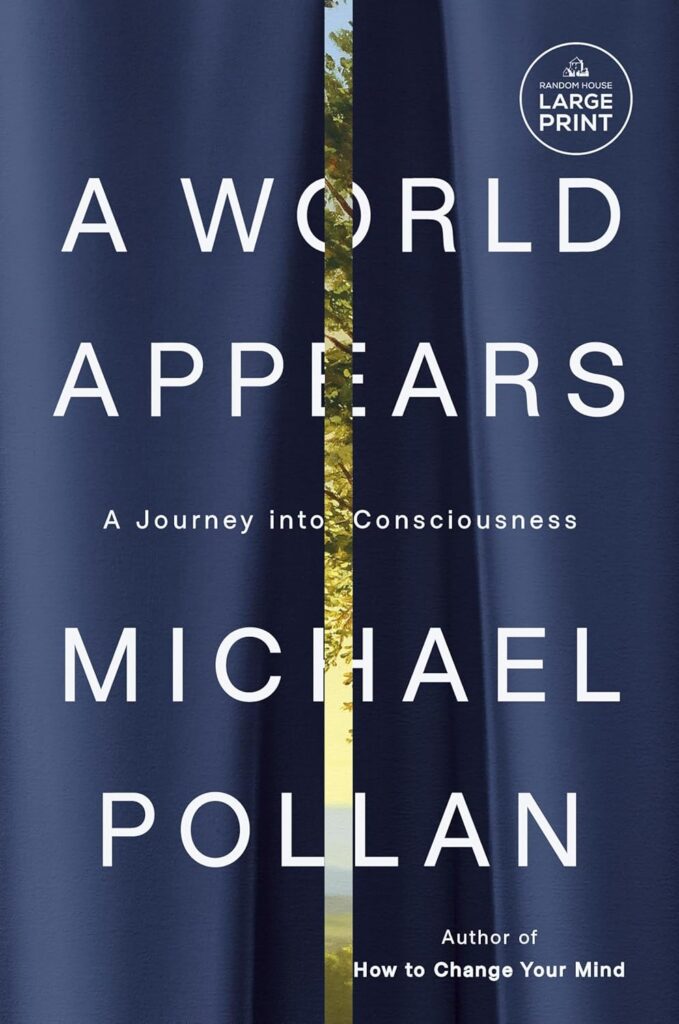
Michael Pollan’s A World Appears presents a groundbreaking exploration of consciousness that bridges science, philosophy, and human experience — and it is emerging as one of the most talked-about books of 2026. This sweeping investigation comes at a moment when questions about the nature of the mind — human, animal, plant, and artificial — are capturing public attention like never before. A World Appears not only examines what consciousness is and how it arises but also why this matters now in an era of advancing AI and renewed interest in how inner experience shapes reality.
Why This Matters Now:
We are living through a cultural moment when artificial intelligence is rapidly developing systems that mimic thought, yet science still struggles to explain subjective awareness. Pollan’s book challenges dominant machine metaphors and urges a richer, more integrated understanding of consciousness that includes emotion, biology, and lived experience — at a time when people everywhere are asking what it truly means to “think” or “feel.”
Rethinking the Mind Beyond Machines and Algorithms
Pollan argues that traditional scientific approaches — especially those rooted in computational and mechanistic models — fall short in explaining the mystery of consciousness. Rather than accepting the brain as merely a processor of information, he invites readers to see awareness as something deeply embedded in the body and lived experience. This includes not just human brains, but potentially other forms of life that exhibit sentience and responsiveness.
Unlike popular AI narratives, which suggest machines could someday “think” like humans, Pollan points out that current artificial intelligence systems process data without inner subjective experience. In other words, they may simulate awareness, but they do not feel hunger, joy, fear, or meaning in the way biological beings do. This critique resonates with scientists and philosophers alike who challenge overly narrow views of the mind.
Pollan’s work distinguishes between sentience — the ability to respond to the environment — and full consciousness, which encompasses awareness of experience, emotion, and self. His emphasis on grounded biological processes highlights how much remains unknown about what makes the mind, well, mindful.
From Plants to Psychedelics — A Broad Map of Awareness
One of the most provocative parts of Pollan’s investigation is his look at non-human life. Drawing on studies in plant neurobiology, he describes how plants exhibit behaviors that resemble learning and memory — not consciousness as we typically define it, but significant responsiveness that challenges old assumptions about sentience.
Alongside this scientific work, Pollan also revisits his own journey into understanding the mind, including reflections informed by personal experiences with psychedelics and meditation. These subjective explorations offer contrasting ways of knowing that cannot be fully captured by objective laboratory methods. By weaving together empirical research with first-person insight, A World Appears invites readers to consider consciousness as both a scientific and experiential frontier.
This approach echoes Pollan’s earlier works, such as How to Change Your Mind, where he used personal narrative to illuminate complex scientific concepts — a style that has helped bring often abstract topics into mainstream conversation.
AI, Emotion, and the Limits of Replication
The question of whether machines could ever become conscious is central to today’s debates about technology, ethics, and the future of humanity. Pollan does not deny that AI can simulate aspects of cognition, but he emphasizes that true subjective experience — the “felt” quality of existence — remains elusive. Contemporary AI may mimic language and behavior, but that does not mean it experiences anything akin to what humans feel.
This distinction has practical implications. If consciousness is inseparable from emotion and biological processes, then efforts to create artificial awareness may be fundamentally limited or misguided. Pollan suggests that focusing too much on artificial consciousness risks neglecting the deeper human capacities and inner worlds that make life meaningful.
At the same time, he cautions that society’s growing reliance on technology could distort our understanding of our own minds. As machines become more integrated into daily life, the risk is not just misunderstanding AI, but losing sight of what makes human consciousness unique — including empathy, self-reflection, and emotional depth.
Why This Book Is Sparking Deep Discussion
Across reviews and interviews, A World Appears is being lauded for its breadth and depth. Critics describe it as both accessible and intellectually ambitious, a work that brings together perspectives from neuroscience, philosophy, literature, and personal experience in ways that are compelling and expansive.
What sets Pollan’s work apart is his ability to address complex scientific debates while still making them relevant to everyday concerns: What does it mean to be alive? How do we relate to the inner lives of other beings? How should society navigate the rise of intelligent machines? These questions place the conversation about consciousness at the heart of modern cultural and technological discourse.
The Broader Impact: From Culture to Policy
Pollan’s book arrives at a moment when lawmakers, technologists, and everyday people are grappling with the ethical and social implications of artificial intelligence and emerging technologies. His emphasis on the experiential and emotional dimensions of consciousness provides a framework for these discussions that goes beyond technical prowess or capability.
As AI continues advancing, debates about regulation, meaning, and the future of human experience will only intensify. A World Appears offers readers a rich vocabulary and thoughtful perspective to engage with these challenges — suggesting that the future of consciousness studies may be as much about what it feels like to be human as what it computes.
Subscribe to trusted news sites like USnewsSphere.com for continuous updates.