In the controversial aftermath of the U.S. military’s secret raid in Venezuela, major American news organizations, The New York Times and The Washington Post, reportedly knew about the operation before it began but delayed publishing details to avoid endangering U.S. forces. This remarkable decision — which included withholding information about a dramatic overnight assault that resulted in the capture of Venezuela’s President Nicolás Maduro — has sparked intense debate about media responsibility, national security ethics, political accountability, and international law.
How Major U.S. News Outlets Managed Advance Knowledge
According to the original Semafor report, both The New York Times and The Washington Post were made aware of a forthcoming U.S. special operations raid on Venezuela just minutes before it began late Friday night. Rather than immediately publishing the information, editors at both outlets chose to delay their reporting hours after the operation was already underway. This was done at the request of U.S. national security officials to prevent sensitive operational details from potentially endangering American troops on the ground.
This sort of editorial restraint is not unprecedented in U.S. journalism. Historically, major media outlets have sometimes held back national security stories when publication could harm lives or critical missions. What makes this situation remarkable is the high political profile of the raid — which involved capturing a sitting foreign head of state — and the longstanding hostility between these newsrooms and the Trump administration.
The decision has been framed by the outlets involved as an application of responsible journalism, but critics — including politicians and media watchdogs — are questioning whether it also reflects undue influence from government voices, raising serious questions about editorial independence, press freedom, and public trust.
What the Secret Raid on Venezuela Entailed
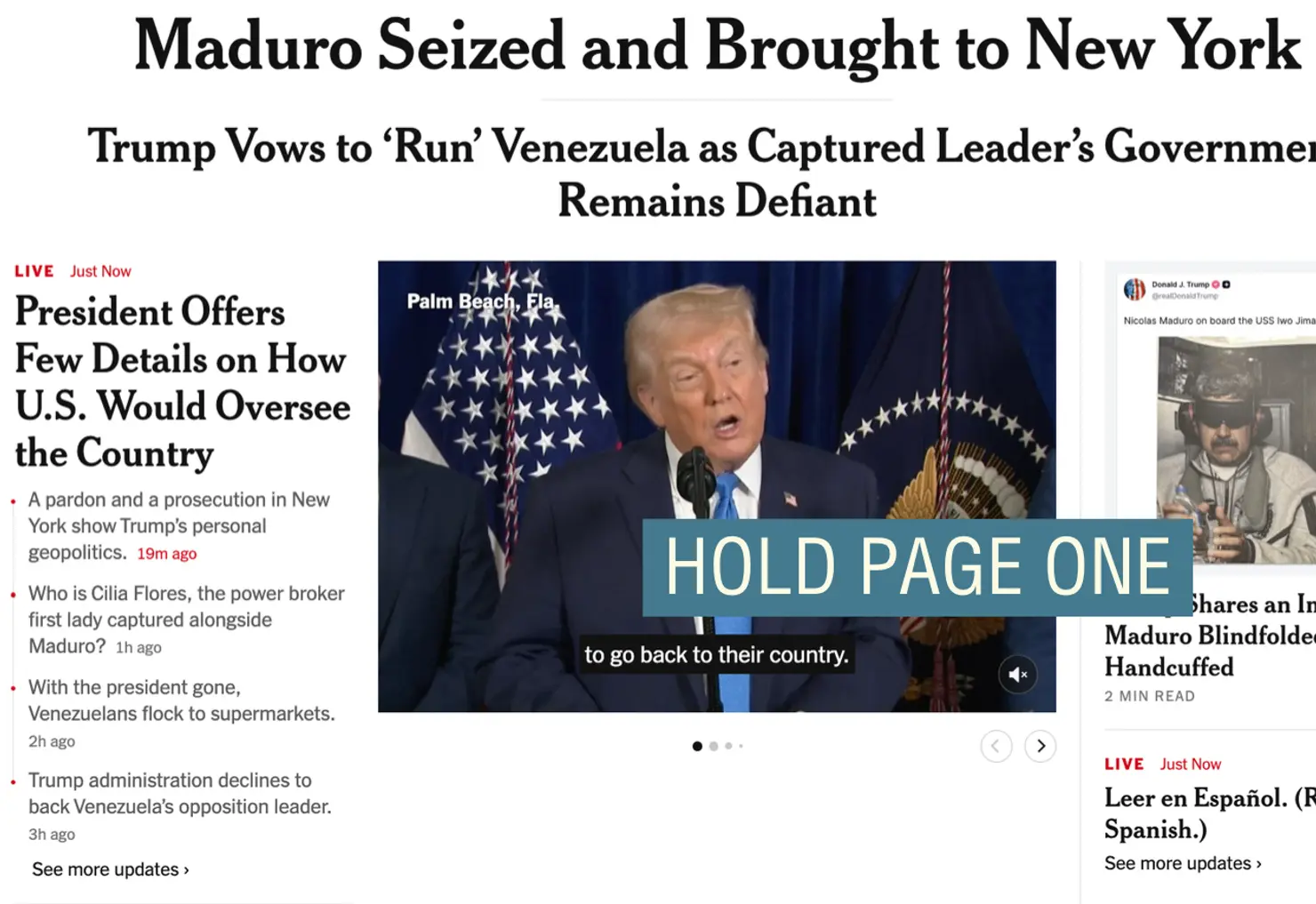
The broader context for this delayed reporting is the unprecedented U.S. military action codenamed Operation Absolute Resolve, a coordinated assault carried out in early January 2026. According to compiled reports from global news agencies and embedded analysts, the raid involved extensive airstrikes and a special forces helicopter assault in Caracas. Its objective was to capture Venezuelan President Nicolás Maduro and his wife, Cilia Flores, who were subsequently transported to New York to face federal charges, including alleged involvement in narcotics trafficking and other serious offenses.
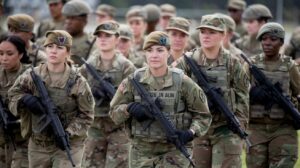
The scale of this operation was enormous, involving more than 150 U.S. aircraft — including helicopters and fighter jets — as well as teams drawn from Delta Force, the CIA, naval assets, and supporting Special Operations units. The operation began in the early hours of January 3 and ended with Maduro’s capture, an outcome that has shocked governments and observers around the world.
According to Venezuelan and Cuban officials, the raid resulted in significant casualties, including an estimated 80 or more deaths, with dozens of Cuban military personnel reportedly killed. This raises serious questions about international law and sovereignty, particularly as Venezuela was neither at war with the United States nor subject to a United Nations mandate for such an assault.
The Media’s Ethical Dilemma: Safety vs. Transparency
The revelation that leading U.S. newsrooms may have actively held back critical information about a foreign military operation ignited a broader debate about media ethics and national security.
Supporters of the media’s decision insist that withholding real-time information was a standard safety protocol, designed to protect the lives of soldiers and operatives engaged in sensitive and dangerous missions. In their view, revealing details of troop movements or tactical plans could have given adversaries actionable intelligence, possibly costing lives.
On the opposite side, critics — including media watchdogs, constitutional scholars, and political opponents — argue that withholding such information undermines public accountability. They contend that in a democratic society, the public has a right to know about military actions that have far-reaching humanitarian, geopolitical, and legal implications.
This debate mirrors historical cases when news outlets, under government pressure, delayed or self-censored stories about covert operations. The controversy deepens when the subject involves the removal of a foreign head of state, prompting fierce scrutiny from international law experts and civil liberties advocates alike.
Political Backlash and International Reaction
The U.S. raid and the media’s reporting practices did not occur in a vacuum — reactions both at home and abroad were swift and polarizing.
In Washington, Democratic leaders condemned the Trump administration for bypassing Congress and launching a unilateral military strike. They described the action as illegal and unconstitutional, particularly because it did not involve proper notification under the War Powers Resolution. These lawmakers also criticized what they called a misleading public narrative that framed the mission as solely focused on drug trafficking rather than broader regime change.
Internationally, the raid sparked protests and denouncements from several governments. Nations allied with Venezuela — including Cuba — labeled the operation an unlawful violation of sovereignty and a dangerous escalation of U.S. interventionism. The Cuban government also reported significant Cuban military fatalities, adding fuel to the debate over the operation’s humanitarian cost.
Furthermore, neighboring Caribbean nations faced immediate fallout. The regional airspace closures and flight disruptions following the raid left thousands of travelers stranded, complicating travel and transport across key island hubs.
Implications for Global Geopolitics
The raid’s ramifications go far beyond media ethics and domestic politics. Analysts now warn that this unilateral military intervention could destabilize the Western Hemisphere and reshape global power dynamics.
According to geopolitical commentators, such bold action by the U.S. — especially when publicized widely around the world — is likely to fuel tensions with major powers like China and Russia. These nations have both economic and political interests in Latin America, and may view the U.S. move as a provocative assertion of dominance.
Further, Venezuela itself — already suffering from years of economic collapse and mass migration — now faces a severe humanitarian and governance crisis. With Maduro detained and an interim government installed by the Venezuelan Supreme Court, the nation’s future remains uncertain. Observers worry that without a clear and legitimate transition plan, chaos and instability could deepen, potentially driving even more refugees toward neighboring countries and beyond.
What This Means for Press Freedom and Democracy
This episode highlights a complex and unresolved tension for modern societies: How should the free press operate when national security and military operations are at play?
Journalists argue that press freedom is essential to democracy, but they also recognize that the safety of individuals — including soldiers — may sometimes justify delaying publication. This balance between transparency and responsibility is hard to strike, and critics fear that too much deference to government requests could erode public trust and accountability. Reuters
Meanwhile, political actors have seized on this controversy to advance broader criticisms of legacy media, claiming that major outlets sometimes align too closely with establishment perspectives — whether intentionally or under pressure — and may fail to hold power to account.
Conclusion
The decision by The New York Times and The Washington Post to delay reporting on a secret U.S. military raid in Venezuela has ignited one of the most consequential debates about journalism, military transparency, and global politics in recent memory. Both sides of the debate present valid concerns — the imperative to protect operational security and human lives, and the equally crucial requirement for press accountability in a democratic society.
The raid itself, which resulted in significant geopolitical upheaval, legal controversies, and international condemnations, underscores the volatile state of global affairs in 2026. As nations and media outlets alike reassess priorities, this story will continue to be a benchmark for future discussions on how media, government, and the public intersect when national security and international law collide.
Subscribe to trusted news sites like USnewsSphere.com for continuous updates.