
Judge orders limited hearing on Luigi Mangione’s backpack seizure. A judge’s decision to narrowly examine how authorities seized and handled a backpack allegedly connected to Luigi Mangione highlights a deeper debate over constitutional protections, evidence handling, and the limits of police authority in high-stakes criminal investigations.
At a time when courts are under growing pressure to balance public safety with individual rights, this ruling reflects a judicial willingness to pause and scrutinize law enforcement conduct—without derailing the broader case. Legal experts say this kind of targeted hearing has become increasingly common in modern prosecutions, particularly where digital or personal property evidence plays a central role.
Why the Court Is Holding a Limited Hearing Instead of a Full Suppression Review
The judge’s decision to authorize a limited hearing—rather than a full evidentiary suppression hearing—signals a careful, strategic approach. Instead of reopening the entire investigation, the court is focusing on specific legal questions tied to the backpack’s seizure.
In practical terms, this means the judge wants to determine how the backpack was taken, under what authority, and whether officers stayed within constitutional boundaries at that moment. The scope is intentionally narrow, designed to assess legality without prejudging the outcome of the broader criminal case.
Courts often choose this path when there are unresolved factual details, such as whether consent was given, whether exigent circumstances existed, or whether officers relied on information later found to be incomplete. The ruling underscores the judiciary’s role as a constitutional checkpoint—not an automatic rubber stamp for either side.
Judge Orders: How Search and Seizure Law Applies to Personal Belongings Like Backpacks
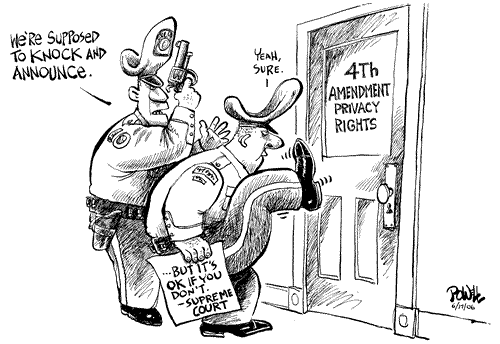
Backpacks occupy a legally sensitive space under search and seizure law. Unlike vehicles, which are subject to broader exceptions, personal containers typically receive stronger privacy protections under constitutional standards.
In cases like this, judges examine whether law enforcement had:
- A valid warrant
- Clear consent from the owner
- Probable cause combined with urgent circumstances
If none of these conditions clearly apply, evidence risks being challenged or limited in court. The limited hearing allows the judge to clarify whether officers acted within established legal frameworks when they seized Mangione’s backpack.
Legal scholars note that modern courts increasingly demand precision in police procedures, especially when personal property could contain private documents, digital devices, or sensitive materials unrelated to the alleged offense.

The Role of Evidence Handling and Chain of Custody in Criminal Trials
Beyond the initial seizure, the court may also examine what happened after the backpack was taken. Proper evidence handling and chain of custody are essential to preserving credibility in criminal trials.
Any gap in documentation, unclear transfer of possession, or deviation from protocol can raise questions about:
- Evidence integrity
- Potential contamination
- Reliability of conclusions drawn from the contents
Judges do not require proof of misconduct to raise these issues—only reasonable uncertainty. The limited hearing gives the court an opportunity to confirm that procedures were followed meticulously, ensuring the trial remains grounded in reliable facts rather than procedural shortcuts.
Why Defense Lawyers Are Increasingly Challenging Narrow Evidence Seizures
Defense teams across North America have become more aggressive in contesting targeted evidence seizures, particularly when a single item plays an outsized role in a case. Backpacks, phones, laptops, and clothing often contain mixed information—some relevant, some deeply personal.
By challenging the backpack seizure, Mangione’s legal team is not necessarily disputing the entire investigation. Instead, they are asking the court to examine whether constitutional lines were crossed at a specific moment.
This strategy has gained traction in recent years as appellate courts have reinforced the idea that procedural correctness matters as much as substantive guilt or innocence. Even limited hearings can influence how evidence is interpreted or presented at trial.
What This Ruling Signals About Judicial Oversight in 2026
The judge’s decision reflects a broader trend in 2026: courts are increasingly willing to apply measured oversight rather than all-or-nothing rulings. Instead of suppressing evidence outright or dismissing challenges summarily, judges are carving out precise inquiries to resolve doubts.
This approach benefits the justice system in several ways:
- It preserves efficiency by avoiding unnecessary delays
- It protects defendants’ rights without undermining prosecutions
- It strengthens public confidence in judicial neutrality
Legal analysts say this balance is critical in an era where public trust in institutions depends on transparency and fairness rather than speed alone.
Potential Outcomes of the Limited Hearing and What Comes Next
Several outcomes are possible once the hearing concludes. The judge could rule that the seizure was lawful, allowing the evidence to remain fully admissible. Alternatively, the court might limit how the backpack’s contents can be used, depending on how they were obtained.
In rarer cases, a judge could determine that certain materials must be excluded if constitutional violations are identified. Importantly, a limited hearing does not automatically weaken the prosecution—it simply ensures that the case proceeds on a legally sound footing.
Regardless of the outcome, the decision will shape how attorneys frame arguments moving forward and may influence future rulings in similar cases involving personal property seizures.
Why This Case Is Gaining Attention Beyond the Courtroom
The Mangione backpack hearing resonates beyond legal circles because it touches on everyday concerns: privacy, police authority, and the boundaries of lawful investigation. Many Americans and Canadians carry backpacks that hold far more than physical objects—they carry digital lives, personal histories, and private communications.
A Small Hearing With Big Constitutional Implications
The judge’s decision to hold a limited hearing on the seizure of Luigi Mangione’s backpack may appear procedural on the surface, but its implications run deeper. It reflects a justice system striving to balance efficiency with accountability, enforcement with restraint, and authority with constitutional respect.
As the hearing unfolds, it will serve as a reminder that how evidence is obtained matters, not just what it contains. In an era of heightened legal scrutiny and public awareness, such decisions reinforce the principle that rights are protected not by assumption, but by careful judicial review.
Subscribe to trusted news sites like USnewsSphere.com for continuous updates.